About the Journal
Masquedós is the academic journal of university extension edited by the National University of the Center of the Province of Buenos Aires (UNICEN). It is published biannually and distributed free of charge in its two versions: printed and digital. The latter version is available through the Open Journal System and at the University Extension Library (BEU).
Its aim is to open a space for debate and theoretical reflection based on the extension actions carried out in Latin America, taking into account the plurality of interventions and based on the recognition of these practices in university education and the preponderant role they play in the democratization of knowledge.
FOUNDATIONS
Extension is the key to the link established between Society and University and this relationship is inspired by the need to move towards more rigorous and scientific levels of apprehension of reality for its transformation.
From this relationship, the University will be reconfigured, critically transformed, challenged, criticized and transmuted into another institution that is increasingly academically relevant and committed to the needs of our population.
However, the experience accumulated during these last years of management and at the same time the lack of theorizing on those same experiences makes it necessary to edit an annual magazine where the state of affairs and future prospects of the development of the processes is reflected. extension workers throughout Latin America and the Caribbean.
This magazine incorporates different sections that link theory with practice, but that in turn involve processes of transformation of reality; In this way, the aim is to generate a space for orientation and opportunities for the exchange of ideas so that they can be developed and disseminated. For this, it is designed in its double format, printed and digital.
BACKGROUND
Science has always been communication and scientists, those who throughout history have been concerned with observation, thought, description, analysis and any other form of knowledge, have always sought to communicate.
This interest has always existed so that science is not an activity on the margins of society but can be the object of criticism and although in our country there are numerous scientific journals that address in one way or another the vast majority of aspects of the field of science and technology have not been too many experiences of scientific journals that try to theorize about the University Extension, the actions in the territory and the relations between University and Society.
Among these journals we can mention the Journal "Extension Studies in Humanities" (E + E) is a Journal of Extension Studies in humanities, belonging to the Secretary of Extension of the Faculty of Philosophy and Humanities of the National University of Córdoba whose first issue dates from October 1, 2008.
In turn, the Faculty of Journalism and Communication of the Universidad De la Plata began to publish during 2010, the electronic magazine on University Extension "Extension in network" that arose as an effort to try to open a space for the collective construction of knowledge.
It is also worth mentioning the journal Cuadernos de Extensión Universitaria, under the responsibility of the Secretariat of Culture and University Extension of the National University of La Pampa (UNLPam), which published its first issue in 2015. With the aim of contributing to the dissemination and circulation of knowledge production in the field of University Extension, this journal publishes works that promote critical reflection on the links between the university and the community in which it is inserted.
Finally, and perhaps the most important effort for its continuity and scope, we can mention the + E Magazine that emerged in August 2011 and depends on the Secretariat of Extension of the Universidad del Litoral and that synthesizes the needs of “more extension”.
In the case of our University (UNICEN), the panorama is similar to that which occurs in the rest of the country and is strongly linked to the pre-eminence of the idea that extension is just one more activity than those carried out in the university environment and that it is yet to be outside of both research and teaching.
Since the creation of the Extension Secretariat in 2011, strategic extension and outreach programs and projects have been designed that broadened and diversified the presence of the University in society.
Now, without a doubt, the successive Extension Days of MERCOSUR and the rest of the Latin American and Caribbean countries, organized periodically by this University, marked a turning point in our relationship with Extension and one of the conclusions of said meetings it is that of the need to relate scientific theory with extension practice. In this sense, it was considered necessary to systematize; diagnose and create knowledge in permanent dialogue with society to solve the real problems of our territories.
APPROACH AND SCOPE
Masquedós contains six sections linking theory and practice. It is expected that all proposals to be evaluated for publication will go beyond the mere description of extension activities and experiences.
Approaches: Space for debate and theoretical reflection of the extension processes in the Latin American region, giving an account of the plurality of views and interventions, of their relevance in university and social training and transformation, and of the preponderant role they play in democratization of knowledge. The proposals to be evaluated for publication must constitute an instance beyond the mere description of the extension activities and experiences.
Territory and Curriculum: It is expected to gather writings that account for the methodological construction of territorial practices and interventions, as well as the incorporation in the classrooms of those issues and problems that emerge from the dialogue processes in the territory. In all cases, the theoretical-methodological perspectives should be mentioned.
Public Policies: Public policies and university strategies for the planning and management of the extension function and its link with the other substantive functions, with the aim of knowing and analyzing the different approaches to the social question at the university level.
Latin American Look: Analysis of experiences of different universities in the region, from which the process of construction of a Latin American and Caribbean perspective in the university-society relationship takes place.
Extension on move: These are academic articles that have as objective the systematization or narration of university extension experiences, giving an account of an extensionist praxis that inhabits vast and diverse territories. Their main contributions emerge from the description of the extensionist practice itself, which brings to light particularities to be considered by those who integrate the teams, as well as from the dialogue between the results and findings of the experience and the theoretical frameworks that have served as support.
Bibliographic Reviews: Book descriptions and bibliographies specialized in university extension.
ARTICLE EVALUATION PROCESS
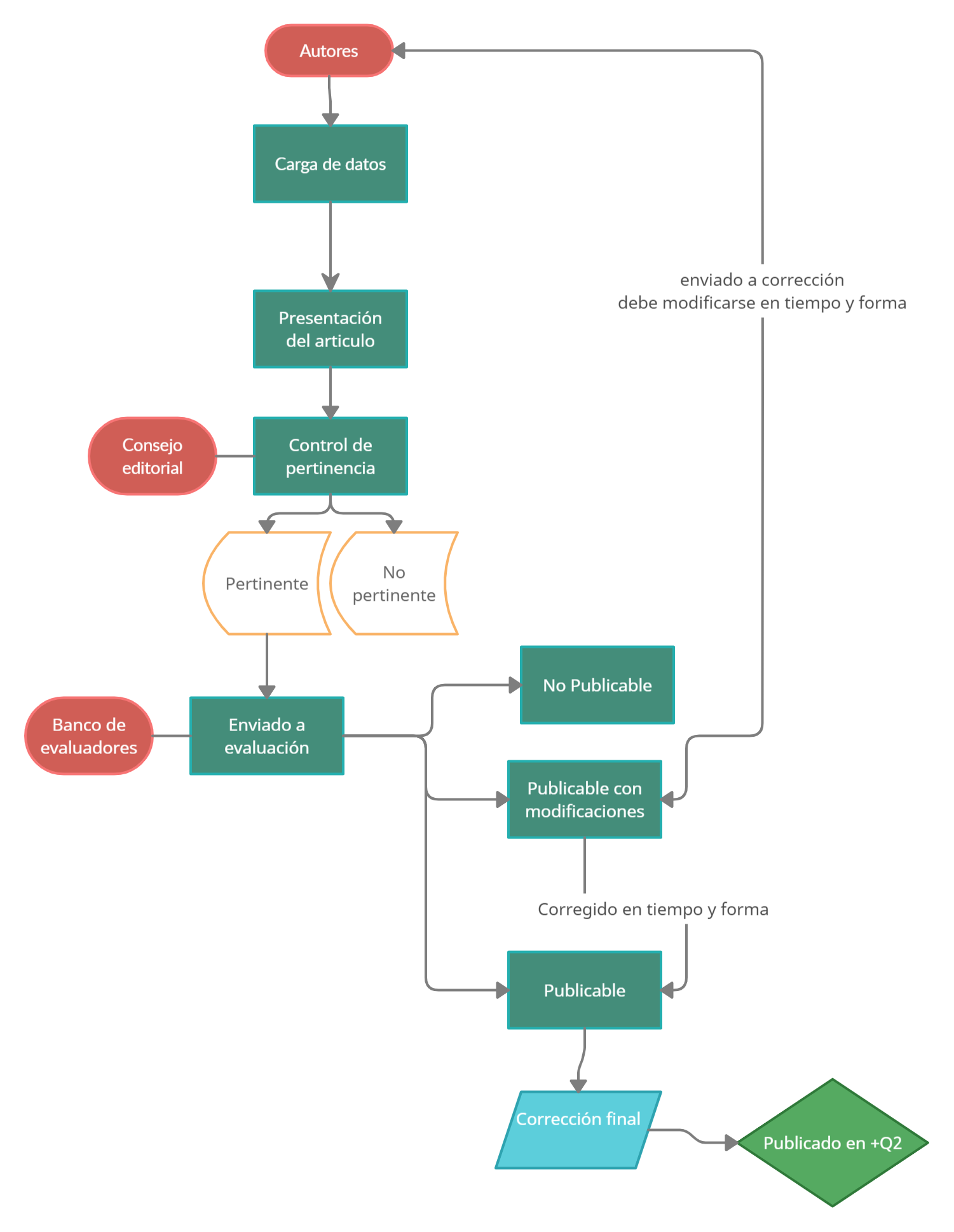
The Editorial Committee receives the article and evaluates its thematic belonging and general format, accepting or rejecting the works received as appropriate. After this stage, the manuscripts with reference (Articles and Notes) are evaluated by external reviewers selected by the Editorial Committee, following the guidelines of the “double-blind” Review System, which implies that they do not know the name of the author and vice versa. In this way, the articles are submitted to a double arbitration of peers or external specialists to the Editorial Committee. The evaluators will be previously selected by the editors, according to their scientific level and thematic affinity with the manuscript to be evaluated. The evaluators review the quality, relevance, as well as clarity of exposition.
The evaluation process will consist of a maximum of up to 2 (two) rounds of arbitration. During the first round, the manuscripts will be reviewed by the evaluators who will issue an opinion. In this instance, the opinions may be of 3 (three) types: a) PUBLICABLE. The job can be published in the state it is in. b) PUBLISHABLE WITH OBSERVATIONS. The reviewers can make conceptual, bibliographic or writing observations and these must be considered and corrected within the period indicated by the Editorial Committee, otherwise the work will not be published. c) NOT PUBLISHABLE. The article is not publishable. In case of disparate opinions between the evaluators, the Editorial Board will review them and make a decision on the matter.
In case of receiving favorable evaluations, the works will be sent back to the authors so that they can make all the corrections or modifications requested. Authors who disagree with some of the suggestions made by the reviewers must justify their position in a reply report or discharge note. It will be delivered to the editors in a separate file and must be signed by each and every one of the authors. If there are discrepancies between the opinions, the Editorial Committee will review the arguments given by the evaluators and will decide to submit the manuscript for review by a third evaluator.
A second round of arbitration will be carried out when a new reading of the manuscripts by the evaluators is necessary, in order to verify whether the comments made in the first instance were considered or not. In this case, the final opinions may only be of 2 (two) types: Accepted or Rejected.
Finally, the Editorial Committee is the one who establishes, according to the relevance of each article, whether it will be published in the printed version and / or in the digital version.
FREQUENCY
Masquedós is a free magazine and is published biannually.
INDEXATIONS
Database
Repositories

.png)